Ten major Uber and Lyft cases, from jury verdicts to confidential settlements, show how rideshare injury claims and insurance disputes can play out very differently.
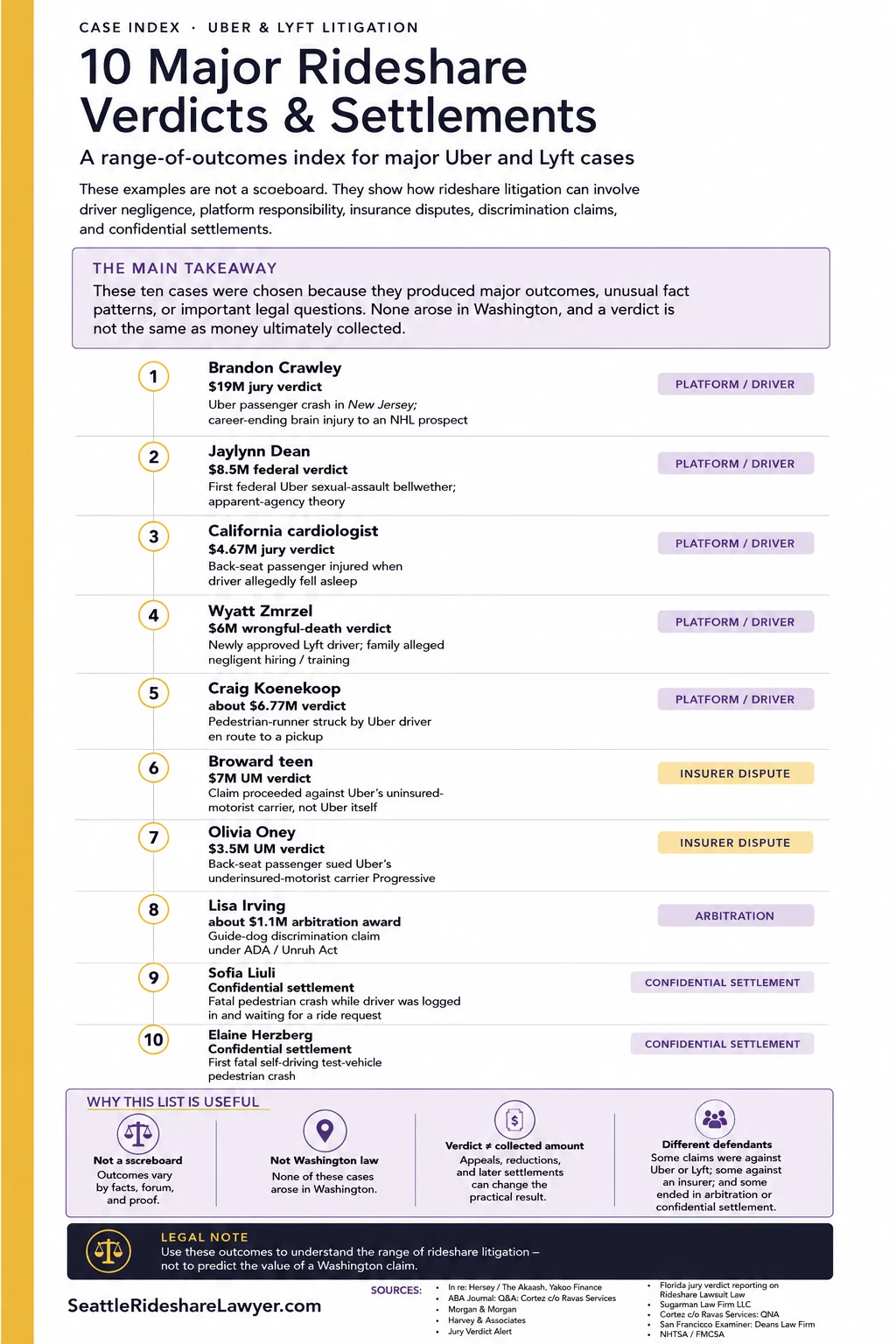
1. Brandon Crawley: $19 Million Verdict Over a Career-Ending Uber Crash
On Christmas Day 2018, Brandon Crawley, a fourth-round NHL draft pick by the New York Rangers, was riding as a passenger in an Uber in Glen Rock, New Jersey. The vehicle left the road and struck a utility pole. Crawley suffered a traumatic brain injury, post-concussion syndrome, and lasting vision problems that ended his professional hockey career after five seasons in the American Hockey League. Crawley sued Uber and the driver in October 2020, arguing that Uber should be held responsible for the driver's negligence. The case turned largely on whether Uber drivers should be treated as employees or independent contractors under New Jersey law, a classification Uber has fought for years. On January 28, 2026, a Bergen County jury sided with Crawley, awarding $15 million for lost future earnings, $3 million for past lost wages, and $1 million for pain and suffering, for a total of $19 million.
Uber's attorneys called the driver an independent contractor and said in a statement that the verdict wasn't legal precedent. As of this writing, post-trial motions and a possible appeal remain pending, so the case is not fully resolved and how much of the verdict Crawley ultimately collects is still an open question. Crawley's attorneys have described it as the largest jury verdict against Uber in the country to date.
2. Jaylynn Dean: $8.5 Million Verdict in the First Federal Uber Sexual Assault Trial
Jaylynn Dean was 19 when she requested an Uber ride home from her boyfriend's apartment in Tempe, Arizona, in November 2023. According to her lawsuit, the driver, Hassan Turay, deviated from the route, entered the back seat where she was lying down, and raped her. The case became the first federal bellwether trial in a massive multidistrict litigation consolidating thousands of sexual assault claims against Uber nationwide. An earlier bellwether trial in a separate California state court proceeding had gone the other way, with jurors finding Uber not liable, which made the outcome in Dean's case closely watched. In February 2026, a nine-member federal jury in Phoenix found Uber liable under an "apparent agency" theory, reasoning that Turay was acting as Uber's agent when the assault occurred. Jurors awarded Dean $8.5 million in compensatory damages. Notably, the jury rejected Dean's separate claims that Uber was directly negligent in vetting or dispatching the driver and that the app itself was defectively designed, and it declined to award any punitive damages despite Dean's attorneys seeking more than $140 million. The verdict does not resolve the thousands of other sexual assault claims pending against Uber, but it gave both sides a real data point on how a jury might value one. As of mid-2026, the case remained on appeal.
3. A Cardiologist's $4.67 Million Verdict Against Lyft
In March 2024, a practicing cardiologist was riding in the back seat of a Lyft on Interstate 10 near Montclair, California, when the driver fell asleep at roughly 40 miles per hour and rear-ended another vehicle. He suffered facial fractures, a pelvic fracture, permanent loss of smell and taste, and ultimately needed a total hip replacement along with two other surgeries. The defense's highest pretrial settlement offer was $2 million. The plaintiff turned it down and took the case to trial, arguing driver fatigue amounted to gross negligence. In May 2026, a San Bernardino County jury returned a verdict of $4,667,549.13, more than double what had been offered before trial. The case is a reminder that pretrial settlement offers, even from a company with deep pockets, don't always reflect what a jury will ultimately award once it hears the full extent of someone's injuries.
4. Wyatt Zmrzel: $6 Million Verdict Over a Newly Approved Lyft Driver
Twenty-two-year-old Wyatt Zmrzel requested a Lyft home from a Sacramento tattoo shop in December 2017. The driver, Rafiullah Amiri, had been approved to drive for Lyft only the day before and had received no training on the safe operation of a vehicle. Instead of taking the most direct route, Amiri drove more than 20 miles in the wrong direction, stopped in the median of Highway 99, and then accelerated into oncoming traffic, where his vehicle was struck by another car traveling at highway speed. Zmrzel died roughly half an hour later. Zmrzel's family sued Lyft for negligent hiring, training, and supervision, arguing the company put an unprepared driver on the road within a day of approving him. In December 2021, a Sacramento County jury returned a $6 million wrongful death verdict. The case is often cited in discussions about how quickly rideshare companies onboard new drivers and what, if any, training they receive before picking up their first passenger.
5. Craig Koenekoop: $6.7 Million Verdict After Being Struck En Route to a Pickup
In December 2018, Craig Koenekoop, then a 30-year-old freelance writer, was out for a run in Los Angeles when an Uber driver named James Thompson, logged into the app and on his way to pick up two passengers, made a right turn and struck him. Koenekoop suffered a clavicle fracture and a closed head injury. Over the following years he developed hip and back problems that he attributed to the collision, including bilateral labral tears that eventually required two rounds of hip surgery. Uber's defense argued much of that later treatment stemmed from a preexisting hip condition unrelated to the crash. Ahead of trial, Uber stipulated to vicarious liability for this case specifically, without conceding any broader classification of its drivers as employees, and Thompson stipulated that he alone was negligent in causing the collision, in exchange for being dismissed from the case. That left Uber as the sole defendant at trial. In April 2024, a Los Angeles County jury awarded $6,768,071.46, commonly reported as roughly $6.7 million, covering both medical costs and pain and suffering. It was described at the time as the first case Uber had allowed to reach a jury verdict in Southern California rather than settling.
6. A Broward Teen's $7 Million Uninsured Motorist Verdict Tied to an Uber Ride
A 15-year-old boy was riding as a passenger in a rental vehicle connected to Uber's driver program when an uninsured, intoxicated driver ran a red light and T-boned the car in Broward County, Florida. The teen, who was unrestrained at the time, was ejected from the vehicle and suffered a traumatic brain injury, memory loss, and orthopedic injuries. Because the at-fault driver had no insurance, the claim proceeded against Uber's uninsured motorist carrier, Southern-Owners Insurance, which had declined to pay policy limits before the case went to court. A Broward County jury ultimately awarded $7 million on the uninsured motorist claim. It's worth being clear about what this verdict actually decided: it wasn't a jury finding Uber itself negligent for the crash. It was a jury deciding what the teen's claim was worth under Uber's own UM coverage after the insurer wouldn't pay it voluntarily, which is its own kind of dispute rideshare passengers can run into.
7. Olivia Oney: $3.5 Million Verdict Against Uber's Insurer
Olivia Oney, a competitive equestrian, was a restrained back-seat passenger in an Uber in Miami when the driver rear-ended another vehicle. She fractured her pelvis in five places and underwent an L5-S1 spinal fusion, followed by a second surgery months later to remove some of the hardware. She still has permanent hardware in her spine. The lawsuit was filed against Progressive Express, which provided Uber's underinsured motorist coverage, rather than against Uber directly. Progressive didn't dispute that Oney was injured, but argued her recovery was more complete than she claimed, pointing to social media videos of her competing on horseback again about five months after the crash. A Miami-Dade jury wasn't persuaded and awarded $3.5 million in 2023. As with the Broward case above, this was an insurance company defending a UM/UIM claim, not a verdict against Uber for the driver's conduct.
8. Lisa Irving: $1.1 Million Arbitration Award Over Guide Dog Discrimination
Lisa Irving is legally blind and relies on a guide dog named Bernie to get around San Francisco. Between 2016 and 2018, she says Uber drivers denied her rides, verbally abused her, or abandoned her in unsafe locations at least 14 separate times because of the dog, including one incident where a driver yelled at her to get out of his car more than a dozen times before leaving her stranded. Irving brought a discrimination claim under the Americans with Disabilities Act and California's Unruh Civil Rights Act. Uber argued it wasn't responsible because its drivers are independent contractors, an argument the arbitrator rejected. In March 2021, arbitrator Rudy Gerber awarded Irving roughly $1.1 million, consisting of $324,000 in damages and about $805,000 in attorney fees and costs, an amount her attorneys described as among the largest ever issued to a single blind claimant in an ADA case. A California court confirmed the award the following month. It's a different kind of case than the crash and assault claims on this list, but it speaks to the same underlying question: how much responsibility a platform bears for how its drivers actually treat passengers.
9. Sofia Liu: Confidential Settlement After a Fatal Pedestrian Accident
On New Year's Eve 2013, six-year-old Sofia Liu was crossing a San Francisco crosswalk with her mother and younger brother when they were struck by a driver logged into the Uber app but not yet carrying a passenger. Sofia died from her injuries; her mother suffered a serious head injury and other trauma, and her brother was also hurt.
Uber initially argued it bore no responsibility because the driver wasn't on an active trip, only logged in and waiting for a ride request. That position became one of the first major tests of how rideshare insurance should work during the gap between a driver going online and accepting a passenger. The Liu family's lawsuit, and the public attention it drew, helped push California to pass legislation requiring rideshare companies to carry contingent liability coverage during that waiting period, a framework other states, including Washington, later adopted in some form. The case settled confidentially in July 2015, at the family's request, and the amount was never disclosed.
10. Elaine Herzberg: Confidential Settlement After the First Fatal Self-Driving Crash
In March 2018, an Uber self-driving test vehicle, a modified Volvo XC90 SUV with a human safety driver behind the wheel, struck and killed 49-year-old Elaine Herzberg as she walked her bicycle across a street in Tempe, Arizona, outside a marked crosswalk. Federal investigators later found the vehicle's software failed to correctly identify her as a pedestrian in time to brake, while the safety driver had been looking down at a phone rather than watching the road. It was the first known pedestrian fatality involving a self-driving test vehicle, and it drew national attention to how autonomous vehicle testing was being regulated, or wasn't. Uber settled with Herzberg's family within about two weeks of the crash, a fast resolution that let the company avoid a drawn-out trial focused on its testing program. The settlement terms were never made public. Separately, the safety driver was later charged criminally and pleaded guilty to a lesser offense, but that case was distinct from the civil settlement with Herzberg's family.
What Washington Riders Can Learn From These Outcomes
Taken together, these cases cover a lot of ground: passenger injuries, pedestrian strikes, a wrongful death, a sexual assault, a disability discrimination claim, and insurance disputes where the fight was with an insurer rather than the rideshare company itself. A few even turned on the same underlying legal question, whether a driver is really an independent contractor or is close enough to an employee that the platform should answer for what happens on a ride. None of these verdicts or settlements sets binding precedent in Washington, and none of them predict what a Washington claim is worth. Washington has its own rules for how fault gets divided, how wrongful death claims work, and what rideshare companies are required to carry in insurance during different phases of a ride. What these cases are useful for is illustrating the range of situations that can turn into a real legal dispute, and how differently they can be resolved depending on the facts, the venue, and who ends up as the named defendant.
If you were hurt in an Uber or Lyft accident in Washington, the specifics of your case, not a headline number from another state, will determine what it's worth.
Talk to the Law Office of J.D. Smith
If you or someone you love was seriously hurt in an Uber or Lyft accident in Washington, we can help you sort out who's responsible and what insurance coverage applies. Rideshare claims often involve more than one policy, and getting that wrong can cost you. Contact the Law Office of J.D. Smith for a free consultation. Past verdicts and settlements, including the ones described above, don't predict the outcome of any other case, including yours.
Join the Conversation
Comments are moderated before publication. Keep it relevant, civil, and respectful of the people involved.