The Issaquah Uber Driver Murder Case That Reached the Ninth Circuit
Date
January 16, 2026
The Issaquah Uber Driver Murder Case That Reached the Ninth Circuit — and Ended in a Confidential Settlement
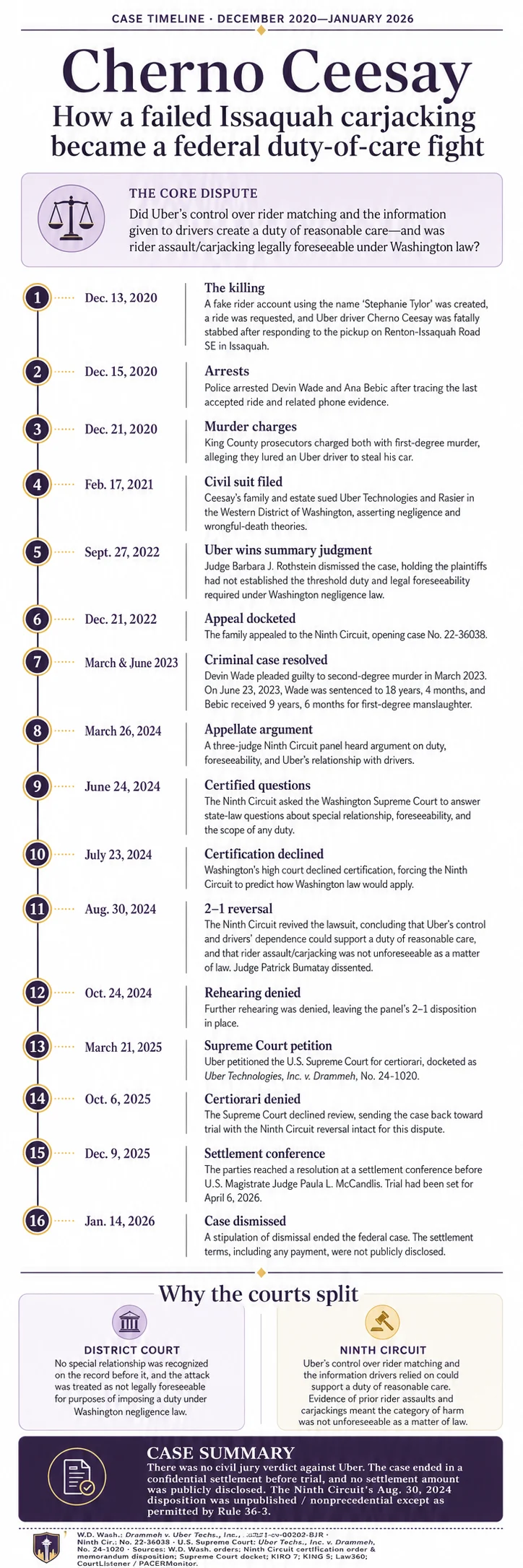
On the night of December 13, 2020, Uber driver Cherno Ceesay accepted what appeared on his screen to be an ordinary ride request.
The rider account was not ordinary.
According to the criminal investigation and the later federal court record, the account was registered under the name "Stephanie Tylor."It had been created shortly before the ride using a prepaid phone and a prepaid gift card. The people allegedly behind it were Devin Wade and Olivia Bebic. Prosecutors later said they were looking for a vehicle to steal. ( KIRO 7, Dec. 21, 2020; W.D. Wash. summary-judgment order, Sept. 27, 2022)
Ceesay arrived at the pickup location along Renton-Issaquah Road Southeast at about 9:18 p.m. Charging documents reported by KIRO placed the creation of the Uber account at roughly 8:50 p.m., the ride request at 9:03, Ceesay's arrival at 9:18, a crash at about 9:25, and the 911 call at approximately 9:35. Ceesay was found inside his vehicle after it struck a tree. He had suffered fatal stab wounds. (KIRO 7)
The criminal cases eventually ended with prison sentences. Wade pleaded guilty in March 2023 to second-degree murder and was sentenced that June to 18 years and four months. Bebic was sentenced to nine years and six months for first-degree manslaughter. (KING 5, June 23, 2023)
But the longer legal story concerned Uber.
For nearly five years after Ceesay's death, his family fought over a much more difficult question than who killed him: What responsibility, if any, did Uber have when its own platform matched a driver with riders whose identities it had not meaningfully verified?
That question produced an initial victory for Uber, an unusual trip through both the Ninth Circuit and the Washington Supreme Court certification process, a 2–1 appellate reversal, a petition to the U.S. Supreme Court, and ultimately a confidential settlement shortly before the case was scheduled to go to trial.
A fake rider account became central to the civil case
Ceesay's parents, Amie Drammeh and Yusupha Ceesay, along with Maram Ceesay as personal representative of his estate, filed suit against Uber Technologies and Rasier in federal court in Seattle on February 17, 2021.
The lawsuit asserted negligence, wrongful death and Washington's statutory claim involving the death of a child. An early punitive-damages theory was dismissed without prejudice in June 2021, but the core negligence case continued. (W.D. Wash. order, June 14, 2021)
The family's argument was not simply that Uber should have somehow predicted Ceesay's murder.
It focused on the structure of the platform.
Uber controlled the digital system that brought riders and drivers together. It decided what information to collect from riders, what verification to require and what information a driver would see before deciding whether to accept a trip.
The record concerning the "Stephanie Tylor" account gave those questions particular significance. The district court described evidence that the account had been created with a prepaid phone and prepaid gift card. The plaintiffs argued that Uber had permitted someone to enter its marketplace, summon a driver to a chosen location and conceal the riders' actual identities behind an account name that was not theirs. (Sept. 27, 2022 order)
The family also introduced evidence concerning prior violence against Uber drivers, including assaults and carjackings. Their theory was that Uber knew its matching system could place drivers in direct physical contact with dangerous riders while leaving the driver dependent on whatever screening and rider information Uber itself chose to provide.
Uber disputed that this created a legally recognized duty.
That dispute became the central issue in Drammeh v. Uber Technologies.
Uber initially won the case without a trial
On September 27, 2022, U.S. District Judge Barbara J. Rothstein granted summary judgment to Uber.
That meant the case was dismissed before a jury could decide whether Uber's conduct had actually contributed to Ceesay's death.
Under Washington negligence law, a plaintiff ordinarily must establish that the defendant owed a legal duty before questions such as breach and causation can go to trial. Criminal conduct by a third party presents an additional complication because the law does not automatically make one person or company responsible for protecting another from someone else's crimes.
The district court concluded that the family had not established the necessary duty.
Specifically, the court rejected the argument that Uber and Ceesay had the kind of "special relationship"that would impose a duty on Uber to protect him from riders' criminal acts. ( Sept. 27, 2022 order)
The court also found the plaintiffs had not established the necessary foreseeability.
One part of the plaintiffs' theory connected Uber's relatively limited rider-verification procedures to the danger presented by anonymous or fraudulent accounts. But the district court found the record insufficient to show a statistically significant connection between fake or anonymous accounts and carjackings.
Viewed through that lens, the sequence leading to Ceesay's death remained too attenuated for the court to impose liability.
Uber had therefore won the most consequential ruling available before trial: the entire case was dismissed on summary judgment.
The family appealed.
The Ninth Circuit saw Uber's relationship with its drivers differently
The appeal reached the U.S. Court of Appeals for the Ninth Circuit as Case No. 22-36038.
After oral argument in March 2024, the appellate panel encountered a problem: the central questions involved Washington tort law, yet Washington's appellate courts had not squarely answered how those principles should apply to a modern rideshare platform.
Rather than immediately decide the questions itself, the Ninth Circuit took the unusual step of asking the Washington Supreme Courtfor guidance.
On June 24, 2024, the federal court certified questions concerning whether a rideshare company has a special relationship with its drivers, whether an attempted carjacking and murder by riders could be legally foreseeable and, if a duty existed, what its scope would be.
The Washington Supreme Court declined to answer the certified questions on July 23, 2024.
That did not end the appeal. It meant the federal judges had to make their own prediction about how Washington's highest court would apply existing Washington law to the relationship between Uber and its drivers. (Ninth Circuit disposition, Aug. 30, 2024)
Five weeks later, the Ninth Circuit reversed Uber's summary-judgment victory by a 2–1 vote.
The reasoning turned heavily on something the district court had not considered sufficient:
Uber's control over the marketplace in which the driver was operating.
"Dependence and control" changed the duty analysis
A driver could choose whether to accept a ride.
The Ninth Circuit majority did not treat that fact as the end of the inquiry.
Once the platform is examined more closely, the court reasoned, the driver does not independently choose who has access to the Uber system, what information riders must provide, how those riders are verified or what information is presented to the driver.
Uber controls those functions.
That distinction mattered to the majority's analysis of a "special relationship" under Washington law.
The court focused on concepts of dependence, control and entrustment. Uber controlled the digital interface that connected Ceesay with the riders. Uber controlled the information available through that interface. And the driver necessarily depended on Uber to perform functions that the driver had no practical ability to perform independently before accepting each request.
Ceesay did not run his own identity check on "Stephanie Tylor."
He did not process the rider's payment himself.
He did not decide what identifying information a passenger had to give before being allowed to summon a vehicle.
Those were features of Uber's system.
The appellate majority therefore predicted that Washington law would recognize a special relationship requiring Uber to exercise reasonable care in matching drivers with riders. (Ninth Circuit, Aug. 30, 2024)
That did not amount to a finding that Uber had actually been negligent.
It answered an earlier question: whether Uber could owe Ceesay a duty at all.
A jury would still have had to resolve the factual questions that followed.
The courts also disagreed about what "foreseeable" meant
Foreseeability became the second major dividing line between the district court and the Ninth Circuit.
The distinction is important because the courts were not necessarily asking the same foreseeability question.
At the summary-judgment stage, there was first a legalquestion: was this kind of harm so unforeseeable that the case should be dismissed as a matter of law?
The Ninth Circuit said no.
The relevant danger, in its view, did not need to be defined as the exact sequence of events that occurred on December 13, 2020: two particular people creating one fraudulent account at a particular time, summoning Ceesay to one location and then attempting to steal his vehicle.
The majority instead looked at the broader category of danger: violent assault and attempted carjacking by riders whom Uber had matched with drivers.
The record contained evidence that Uber was aware drivers had previously experienced assaults and carjackings.
That was enough, the majority concluded, to prevent the court from saying the danger was legally unforeseeable altogether. (Ninth Circuit disposition)
But that ruling did not establish the factual foreseeability necessary to impose liability.
That issue would still have belonged to the factfinder on remand: whether the attack on Ceesay fell within the general field of dangerthat made Uber's alleged conduct negligent under the circumstances.
The difference is easy to miss but central to understanding the result.
The Ninth Circuit did nothold that Uber caused Ceesay's murder.
It did notfind Uber negligent.
It did notaward damages.
It held that the district court had resolved the duty and foreseeability questions too broadly against the family and that the evidence was sufficient for the lawsuit to continue.
The prepaid phone and payment method mattered because Uber controlled the gate
The "Stephanie Tylor" account was relevant for more than its false name.
The district-court record described the use of a prepaid phone and prepaid gift card in establishing the rider account.
Those details fed directly into the plaintiffs' larger argument about control.
A rideshare driver generally cannot conduct a meaningful identity investigation while a ride request is waiting on the screen. The information available to the driver is the information the platform has chosen to collect and expose through the app.
The family therefore argued that Uber occupied the point at which potentially anonymous riders entered the system.
The Ninth Circuit's reasoning did not create a blanket rule requiring one particular form of rider identification. Nor did it hold that accepting prepaid phones or payment methods was itself negligent.
Instead, those facts helped illustrate why the majority believed the relationship involved dependence: Uber possessed control over information and verification processes that the driver did not possess.
That was enough for the majority to reject the district court's conclusion that no special relationship existed as a matter of law. (Ninth Circuit disposition)

Judge Bumatay dissented
The Ninth Circuit's ruling was not unanimous.
Judge Patrick Bumatay dissented from the decision to reverse summary judgment.
That division matters because the majority was predicting Washington law after Washington's own Supreme Court had declined the invitation to answer the certified questions.
Uber later made that circumstance part of its argument for U.S. Supreme Court review, contending that the Ninth Circuit had improperly expanded state tort law after the state's highest court declined certification.
The majority's ruling nevertheless controlled the remainder of Drammeh.
Summary judgment was reversed, and the case returned to federal district court for further proceedings.
The August 2024 ruling was not published precedent
The status of the Ninth Circuit decision needs to be stated carefully.
The August 30, 2024 disposition expressly says that it is "not for publication"and "not precedent except as provided by Ninth Circuit Rule 36-3."( Ninth Circuit disposition)
That means the case should not be described as creating a new binding rule for every Washington rideshare lawsuit.
It was decisive in Drammeh. Its analysis of platform control, driver dependence and foreseeability is legally noteworthy. But an unpublished federal appellate disposition does not become binding statewide Washington precedent simply because the court had to interpret Washington law.
The Washington Supreme Court never adopted the Ninth Circuit's formulation.
That limitation became particularly significant once Uber sought review in Washington, D.C.
Uber asked the U.S. Supreme Court to intervene
After rehearing was denied in the Ninth Circuit on October 24, 2024, Uber Technologies and Rasier sought review from the U.S. Supreme Court.
Uber filed its petition for a writ of certiorari on March 21, 2025, after Justice Elena Kagan granted additional time for the filing.
The petition placed the Ninth Circuit's treatment of state tort law before the nation's highest court and challenged the appellate decision that had revived the family's claims. (U.S. Supreme Court docket, Uber Technologies, Inc. v. Drammeh, No. 24-1020)
On October 6, 2025, the Supreme Court denied certiorari.
A denial of certiorari is not an endorsement of the Ninth Circuit's reasoning. The Supreme Court ordinarily gives no explanation for declining review, and a cert denial does not convert the underlying decision into Supreme Court precedent.
What it did mean for the parties was straightforward: Uber had exhausted that route for overturning the appellate judgment.
The Ninth Circuit's reversal remained intact, and Drammeh headed back toward trial.
The case was scheduled for an April 2026 trial
Back in the Western District of Washington, the litigation resumed.
The case was ultimately set for trial on April 6, 2026.
Had the case reached a jury, the family still would have faced consequential unresolved questions.
The Ninth Circuit had determined that Uber could owe a duty and that rider assault and carjacking were not legally unforeseeable as a categorical matter.
A jury still could have been required to determine issues including whether Uber breached the duty of reasonable care the Ninth Circuit recognized; whether Ceesay's murder fell within the factual field of danger presented by the alleged shortcomings in Uber's system; whether any alleged breach caused the harm; and, if liability were established, the amount of compensable damages.
None of those questions produced a jury verdict.
The case settled first.
A December 2025 settlement conference ended the litigation
On December 9, 2025, the parties participated in a settlement conference before U.S. Magistrate Judge Paula L. McCandlis.
The matter was resolved before the scheduled April trial. Subsequent reporting described the terms as confidential. (Law360, Jan. 2026; docket-based settlement report)
On January 14, 2026, the parties filed a stipulation dismissing all claims, and the federal docket records the case as terminated. (CourtListener)
The amount paid, if any, has not been publicly disclosed.
There was no civil damages verdict.
The distinction is especially important in this case because the family did achieve an important appellate victory. But reversing summary judgment is not the same thing as winning liability at trial.
The Ninth Circuit gave the family the opportunity to present the surviving case. The settlement ended the litigation before a jury could decide it.
What Drammeh v. Uber does — and does not — establish for Washington rideshare cases
Drammeh is significant because a Ninth Circuit panel rejected the proposition that Uber's relationship with its drivers could be treated as legally hands-off simply because the immediate violence was committed by riders.
The majority focused on the practical architecture of rideshare work: the platform controls the matching system, controls what it requires from riders, controls what information reaches drivers, and places the driver in a position of dependence on those choices.
It also rejected an extremely narrow approach to foreseeability. The relevant question was not whether Uber could have predicted the precise murder of Cherno Ceesay by Devin Wade and Olivia Bebic on one stretch of Renton-Issaquah Road. For purposes of deciding whether the lawsuit could proceed, the relevant category was rider violence, including assault and attempted carjacking, viewed against evidence concerning Uber's knowledge of previous incidents.
But the decision has firm limits.
It was an unpublished Ninth Circuit disposition, not binding Washington Supreme Court precedent. It did not hold that Uber is automatically liable whenever a driver is attacked. It did not establish that every use of an anonymous, prepaid or falsely named rider account constitutes negligence. It did not decide breach, factual causation or damages in Ceesay's case.
And because the parties settled before trial, no jury ever answered those questions.
What Drammeh ultimately established in its own litigation was narrower but consequential: under the Ninth Circuit majority's prediction of Washington law, the family had presented enough on duty and foreseeability to get past summary judgment and continue toward trial.
After more than four years of civil litigation, that trial never happened.
The case ended instead with a confidential agreement and a January 14, 2026 dismissal.
Sources
- U.S. District Court for the Western District of Washington, June 14, 2021— Early order addressing the complaint, claims and punitive damages.
- U.S. District Court for the Western District of Washington, Sept. 27, 2022— Summary-judgment order addressing rider-account facts, verification, duty and foreseeability.
- U.S. Court of Appeals for the Ninth Circuit, Aug. 30, 2024— Unpublished 2–1 disposition reversing summary judgment.
- U.S. Supreme Court, Uber Technologies, Inc. v. Drammeh, No. 24-1020— Petition filed March 21, 2025; certiorari denied October 6, 2025.
- KIRO 7, Dec. 21, 2020 — "Man, woman face murder charges in death of Uber driver"— Charging-document reporting on the killing and timeline.
- KING 5, June 23, 2023 — "Suspect in Issaquah Uber driver murder sentenced"— Criminal pleas and sentences for Devin Wade and Olivia Bebic.
- Federal docket — Drammeh v. Uber Technologies, Inc.— January 14, 2026 termination following the parties' stipulated dismissal.