LJDS • April 21, 2026

2 Uber Assault Trials, 2 Different Awards: $8.5M vs. $5000

Date

April 21, 2026

Share

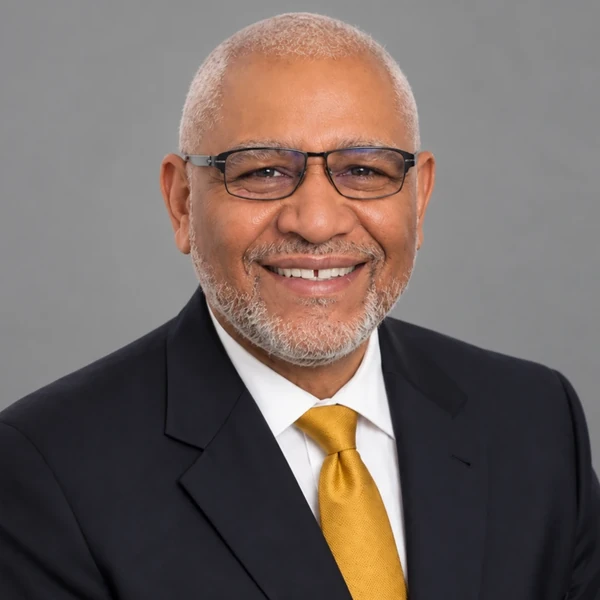
Smiling man in a dark suit with a gold tie, seated against a white background.

About Attorney

J.D. Smith

Before representing injury victims, J.D. Smith worked in insurance claims and defense. That experience gives him firsthand insight into how insurers evaluate and defend accident claims. Tell us what happened with your rideshare case. We’d like to hear about it.


Contact J.D. Smith

Two Uber Sexual Assault Trials, Two Very Different Awards: $8.5 Million vs. $5,000

Thousands of sexual-assault lawsuits against Uber have been moving through federal court together. In early 2026, two of those cases reached juries.


Both resulted in findings against Uber.


One ended with an $8.5 million award.


The other ended with $5,000.


That enormous difference is more useful than either verdict standing alone. It shows why the growing litigation over assaults by rideshare drivers cannot be reduced to a simple question of whether Uber “wins” or “loses.”


Even when jurors agree that the company can be held legally responsible for a driver’s conduct, the facts surrounding the assault, the legal theory being presented and the evidence of resulting harm can dramatically change the outcome.


It also helps explain why these particular trials were being watched far beyond the individual plaintiffs involved.


Why Were These Two Uber Cases Being Tried Separately?


In 2023, the federal judiciary centralized a growing number of lawsuits accusing Uber of failing to adequately address sexual assault by drivers.


The U.S. Judicial Panel on Multidistrict Litigationconcluded that the cases shared substantial factual questions, including what Uber knew about sexual assaults involving drivers, the adequacy of its background checks and what safety measures the company had implemented.


The cases were consolidated for coordinated proceedings before U.S. District Judge Charles Breyer in the Northern District of California. The panel’s original transfer order is available in In re Uber Technologies, Inc., Passenger Sexual Assault Litigation, MDL No. 3084, Transfer Order.


Consolidation did not transform thousands of individual allegations into one giant lawsuit.

Individual passengers still had different drivers, different encounters, different injuries and, in many cases, different state laws governing their claims.


By April 2026, Reuters reported that Uber was facing more than 3,300 similar cases in the consolidated federal litigation, according to Uber loses another US driver sex assault trial, ordered to pay $5,000.


Courts sometimes select individual cases from litigation that large and try them first to see how juries respond to recurring questions.


Lawyers call those bellwether trials.


In ordinary English, they are essentially test cases. They do not decide every other lawsuit. Instead, they give both sides information about which arguments work, which defenses succeed and how juries may value different kinds of claims.


Reuters described the Uber trials as cases intended to help gauge the remaining litigation and potentially inform eventual settlements in Uber ordered to pay $8.5 million in trial over driver sex assault claims.


The first two federal test cases produced strikingly different answers.

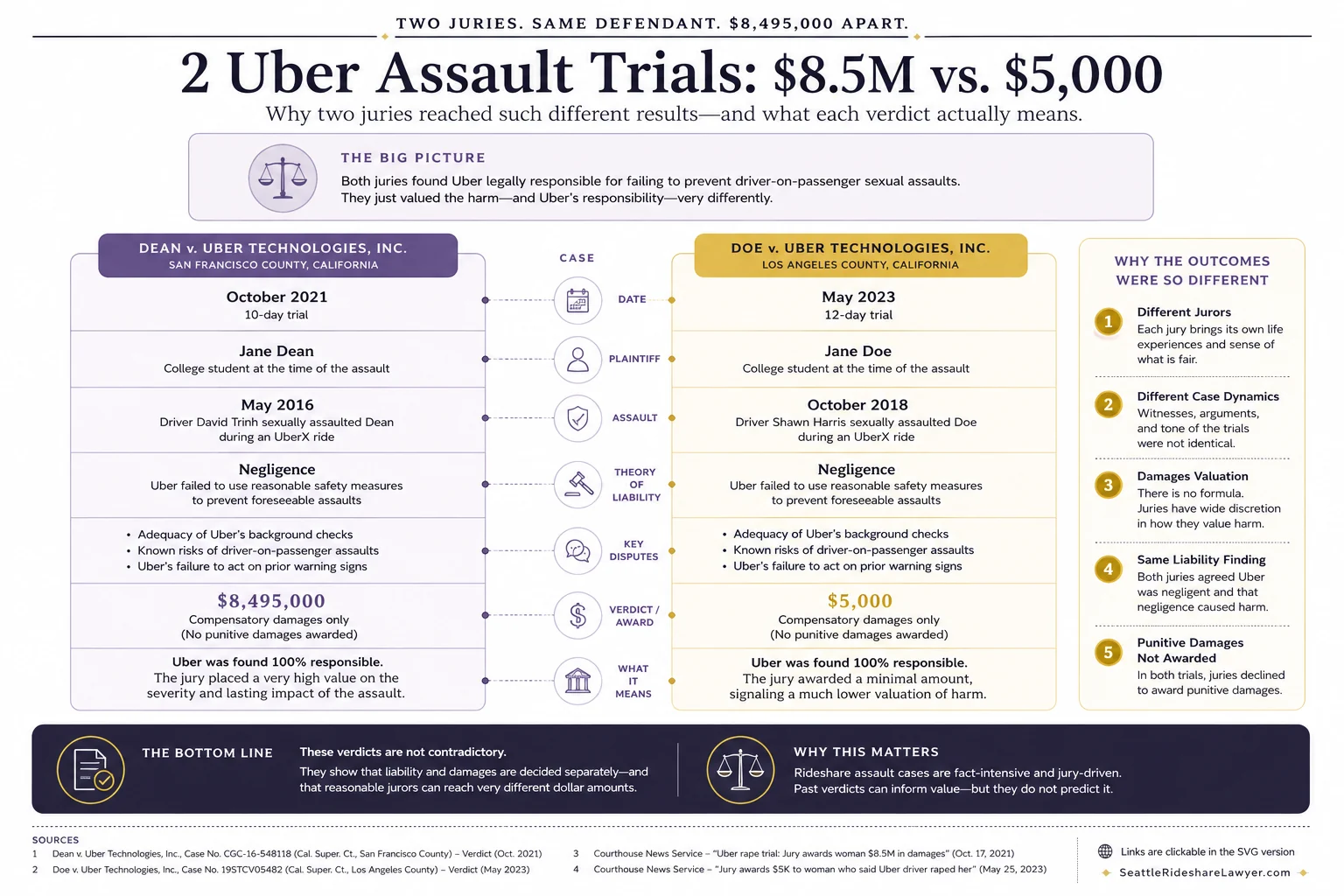
Infographic comparing two jury verdicts for the same defendant, showing a considerable difference.

Jaylynn Dean's Case: An $8.5 Million Verdict

The first federal trial involved Jaylynn Dean, who was 19 when she requested an Uber ride in Arizona in November 2023.


Dean alleged that her driver sexually harassed her during the trip, stopped the vehicle and raped her. She later sued Uber.


Uber disputed that it should be legally responsible for the driver’s criminal conduct.


According to Uber ordered to pay $8.5 million in trial over driver sex assault claims, Uber argued that its drivers are independent contractors and that the driver involved had no criminal history, had completed approximately 10,000 trips and maintained a nearly perfect rider rating.

Uber’s attorneys argued that the alleged assault was therefore not something the company could reasonably have foreseen.


Dean’s lawyers advanced several theories against Uber.


The jury did notaccept all of them.


Jurors rejected claims that Uber itself had been negligent and that its safety systems were defectively designed. They also declined Dean’s request for punitive damages.


But they accepted another theory that proved decisive: agency.


The jury concluded that the driver was acting as Uber’s agent, allowing Uber to be held legally responsible for his conduct.


Jurors awarded Dean $8.5 million in compensatory damages.


That distinction matters.


The verdict was not simply a jury declaring that “Uber’s safety system failed.” In fact, the jury rejected claims built specifically around Uber’s own negligence and product design.


Instead, Uber’s liability came through the legal relationship the jury found between the company and the driver.


Uber announced that it would appeal.


Two Months Later, Another Jury Heard a Very Different Case


The second federal trial began in North Carolina in April 2026.


The plaintiff, whose name was withheld from public court filings, alleged that she ordered an Uber ride in Raleigh in March 2019.


According to her claim, when the vehicle arrived at her destination shortly before 2 a.m., the driver grabbed her inner thigh and made a sexual comment. She fled from the vehicle.

Reuters reported before trial that Uber did not deny the incident occurred, although the company disputed its own legal responsibility. The background to that trial is detailed in Uber faces second driver sexual assault trial following $8.5 million verdict.


Uber again argued that it was a technology company whose drivers operate as independent contractors.


The company also raised a state-law issue that had not been central to Dean’s Arizona case: whether Uber should be treated like a common carrier, such as a traditional taxi service, with heightened obligations toward passengers under North Carolina law.


And there was another major difference.


Uber disputed the extent of the plaintiff’s damages.


Its attorneys argued that she had not demonstrated that the encounter caused the psychological harm for which she sought compensation and pointed to medical history predating the incident. The plaintiff’s lawyers contested Uber’s characterization of that evidence.


On April 20, 2026, the jury returned its verdict.


Uber was ordered to pay $5,000, according to Reuters.


$8.5 Million and $5,000 Are Not Contradictory Results


On the surface, the awards almost look impossible to reconcile.


They are not.


A civil case generally involves more than one question.


There is the question of liability: Is this defendant legally responsible?


Then there is causation: What harm did the legally wrongful conduct actually cause?


Then there are damages: What amount of money fairly compensates for that harm under the evidence presented?


Two juries can reach similar conclusions on the first question while reaching completely different conclusions on the others.


Dean alleged rape and presented a claim involving substantial psychological trauma. Her jury awarded $8.5 million.


The North Carolina plaintiff alleged unwanted touching and a sexual remark. Uber aggressively contested her evidence of resulting harm, and the jury awarded $5,000.


The gap between those awards does not establish a going “price” for any particular kind of assault.


It demonstrates something more basic about civil litigation:


Proving that a defendant can be held responsible does not predetermine the amount of damages.


The evidence still matters enormously.


The Independent-Contractor Defense Did Not End Either Case


Another reason the trials are significant is Uber’s longstanding position that drivers using its platform are independent contractors rather than employees.


That classification matters in many areas of law, but calling someone an independent contractor does not automatically answer every question about whether a company may bear responsibility for that person’s conduct.


Dean’s case is the clearest example.


Her jury rejected direct-negligence theories against Uber but nevertheless found the company responsible after concluding that the driver was acting as its agent.


The second trial again forced jurors to confront Uber’s argument that it should not be legally responsible for conduct committed by an independently contracted driver.


Uber said after the $5,000 verdict that it believed the jury had been incorrectly instructed on liability and that it had grounds for appeal, as reported in Uber loses another US driver sex assault trial, ordered to pay $5,000.


Neither verdict therefore ends the larger debate over the legal relationship between rideshare companies and the people driving passengers through their platforms.


But neither supports the idea that the words “independent contractor”automatically end the liability analysis.


There Was Already Evidence That Uber Could Prevail in These Cases


The two federal verdicts also should not be read in isolation.


Uber faced a separate coordinated group of sexual-assault cases in California state court.

In September 2025, a jury there reached another unusual result.


It found that Uber had been negligent in the safety measures it provided, but also concluded that Uber’s negligence was not a substantial factor in causing the plaintiff’s assault.


Because the required causal connection was missing, Uber was not held liable to the plaintiff.

That earlier result was discussed alongside the federal litigation in Uber ordered to pay $8.5 million in trial over driver sex assault claims.


Taken together, the three trials illustrate three materially different paths:

  • A jury can find problems with Uber’s conduct but conclude those problems did not cause the particular assault.
  • A jury can impose responsibility and award millions of dollars.
  • A jury can impose responsibility but award comparatively little.


That is a much more accurate picture of the litigation than treating a single large verdict as proof that thousands of remaining cases will produce the same result.


What Do These Trials Mean for the Thousands of Other Uber Lawsuits?


Not nearly as much as a class-action headline might suggest, but considerably more than nothing.


The federal cases are part of multidistrict litigation, commonly shortened to MDL.


That procedure allows cases sharing factual issues to be coordinated rather than forcing thousands of courts to repeatedly litigate the same discovery disputes, company records and recurring legal questions.


But the individual claims remain individual claims.


That is precisely why test trials are useful.


The $8.5 million Dean verdict showed that a jury was willing to hold Uber responsible through an agency theory even after rejecting direct-negligence claims.


The $5,000 North Carolina verdict showed that establishing responsibility does not necessarily translate into a large damages award.


And Uber’s earlier California victory showed that even a finding of corporate negligence is insufficient where the plaintiff cannot establish the necessary causal connection.


Together, those results provide both sides with information that no legal brief can supply:


How actual juries react to these arguments.


They may eventually affect settlement discussions. They may influence which cases plaintiffs’ attorneys or Uber choose to try next. And appellate courts may still alter some of the legal rules being tested.


What they do not do is decide the remaining lawsuits automatically.


What This Means for Washington Rideshare Cases


Neither the Arizona verdict nor the North Carolina verdict establishes Washington law.


A Washington case involving an assault during an Uber or Lyft ride would have to be evaluated under Washington law and its own facts: what happened, what the platform knew, the driver’s relationship with the company, what safety measures were in place, what evidence exists and which particular legal theories apply.


That distinction becomes especially important when national rideshare litigation generates large headlines.


An $8.5 million verdict elsewhere does not guarantee an $8.5 million Washington case.


A $5,000 verdict elsewhere does not establish that another survivor’s damages are worth $5,000.


And the existence of thousands of similar lawsuits does not make those lawsuits identical.


The first two federal Uber sexual-assault trials actually demonstrate the opposite.


Two passengers.


Two alleged assaults.


Two juries considering Uber’s responsibility.


And two results separated by $8,495,000.


That may be the clearest evidence yet that the next phase of rideshare assault litigation will turn not simply on whether Uber can ever be held accountable for a driver’s conduct, but when, why and for how much.


Sources

White self-driving car on a busy city street with pedestrians and storefronts in the background
By LJDS August 20, 2026
Waymo has placed Seattle in its expansion plans. Here is what that means now, what a future rider can expect from pickup to drop-off, and what to do if a driverless trip does not go as planned.
By LJDS August 12, 2026
People routinely search for a simple answer to whether taxis or rideshare vehicles are safer. The federal data do not support a clean nationwide winner.
By LJDS August 11, 2026
Uber and Lyft both publish safety data, but the reports are not a scoreboard. Different reporting periods, definitions and disclosure practices make for...
By LJDS August 11, 2026
A July 2026 Government Accountability Office report concluded that the United States still does not have a complete nationwide picture of assaults involving rideshare and taxi trips.
Driver silhouette with Seattle, WA in rearview
By LJDS August 8, 2026
Learn how dashcam footage led to the conviction of a rideshare driver. Contact us for legal help with rideshare accident cases.
View from a car interior on a road toward a distant city skyline, with trees lining the sides.
By LJDS August 5, 2026
Learn about Wenjian Zhuo's case where dashcam footage led to his drug conviction. Contact us for legal help with rideshare accidents.
Driver’s hands on the wheel inside a yellow car on a city street
By LJDS July 25, 2026
Understand rideshare accident liability in WA. Get expert help for your claim against Uber or Lyft. Contact us for free case review.
By LJDS July 25, 2026
Robotaxis change the cast of a crash case. When no human rideshare driver is controlling the vehicle, the investigation can shift toward the automated-driving...
Rideshare pick-up zone sign beside a covered curbside area and trees
By LJDS July 24, 2026
Review 10 key rideshare verdicts & settlements highlighting Uber & Lyft liability. Contact us for expert legal assistance!